Archive
- January (22)
- February (24)
- March (22)
- April (21)
- May (23)
- June (21)
- July (23)
- August (23)
- September (21)
- October (23)
- November (21)
- December (20)
AWEA: Stuck on Stupid (Bode bails wealth-destroying, rent-seeking racket)
By <a class="post-author" href="/about#llinowes">Lisa Linowes</a> -- December 17, 2012“The sheer ridiculousness of the [six-year, front loaded PTC extension] outraged Congressional members and may well have changed the debate. It’s NO coincidence that within 24-hours of AWEA’s poorly received proposal, Denise Bode bailed. A move that sudden suggests the industry thinks it’s better off without her and probably without AWEA’s inflexible, out-of-touch campaign.”
The American Wind Energy Association’s relentless, year-long lobbying campaign to secure extension of the wind production tax credit (“PTC”) hit major headwinds last week, which precipitated the abrupt resignation of its CEO, Denise Bode.
Branded the “Save USA Wind Jobs,” AWEA’s plan tried to stigmatize Congressional members from Red and windy states with the argument: oppose the PTC, and you oppose American jobs.
But rather than gaining support, resistance intensified to extending the PTC. With only two weeks remaining in 2012, it’s not certain what will happen with the subsidy, but one thing is clear: AWEA’s robotic jobs jab has chilled its effectiveness.…
Wind Benefit Inflation: JEDI (NREL) Model Needs Reality Check
By <a class="post-author" href="/about#llinowes">Lisa Linowes</a> -- December 12, 2012Since 2009, the State of New Hampshire has reviewed three large-scale wind energy facilities, totaling 177 megawatts. In each case, the project proponents engaged University of New Hampshire Professor and economist Ross Gittell and his research assistant, Matt Magnusson, to conduct economic impact studies to show the long-term (20-year) benefits the projects would deliver to the local area.
Figure 1 summarizes the findings of each report (please click for better resolution).
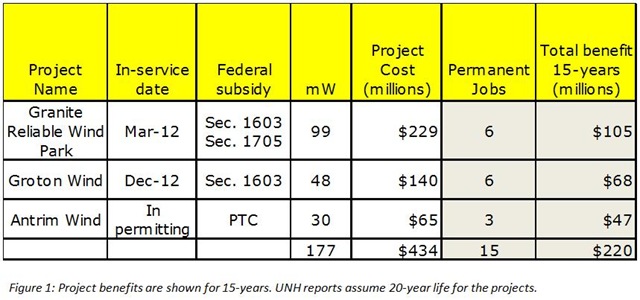
The UNH researchers relied on NREL’s Jobs and Economic Development Impacts (JEDI) or similar linear spreadsheet models to assess job creation and economic impacts for the three projects: Granite Reliable Wind Park, Groton Wind and Antrim Wind. The methodologies and assumptions for the three studies appear nearly identical.
In all cases, their reports showed minor direct job opportunities (15 full-time equivalent positions for operations at the three sites) but substantially inflated indirect and induced job benefits relative to the local area.…
Governors Demand Wind PTC to Cover State Costs
By <a class="post-author" href="/about#llinowes">Lisa Linowes</a> -- November 16, 2012“The Governors know that the federal PTC disproportionately benefits States with renewable mandates by distributing the high cost of their policies to taxpayers at large. They also understand that eliminating the PTC will impose the full burden of costly renewable mandates squarely on the States who enacted them. If California, New York, and Minnesota mandate large wind development, it’s appropriate they bear the full cost of their energy choices.”
The United States is in the midst of a fiscal crisis. If Congress and the White House are unable to reach agreement on spending by January 1, crushing tax increases and draconian budget cuts will go into effect sending the country’s already weakened economy into another destructive recession.
Against this backdrop, the 23-member Governors’ Wind Energy Coalition put aside their own states’ $2+ trillion deficits[1] to deliver a message to Congress — extend the wind production tax credit (PTC).…